HD 82943
HD 82943
| Ascension droite | 09h 34m 50,7352s[1] |
|---|---|
| Déclinaison | −12° 07′ 46,363″[1] |
| Constellation | Hydre |
| Magnitude apparente | 6,54[2] |
Localisation dans la constellation : Hydre  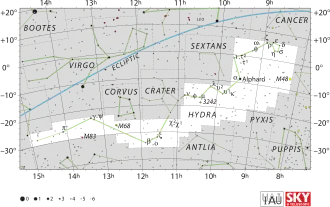 | |
| Type spectral | F9VFe+0.5[3] |
|---|
| Vitesse radiale | +8,102 km/s[4] |
|---|---|
| Mouvement propre |
μα = +1,513 mas/a[1] μδ = −174,718 mas/a[1] |
| Parallaxe | 36,215 8 ± 0,037 8 mas[1] |
| Distance | 27,612 3 ± 0,028 8 pc (∼90,1 al)[1] |
| Masse | 1,18 M☉[2] |
|---|---|
| Rayon | 1,12 R☉[2] |
| Luminosité | 1,57 L☉[1] |
| Température | 5 874 K[2] |
| Métallicité | [Fe/H] = 0,32[2] |
| Âge | 3,08 × 10⁹ a[2] |
Désignations
HD 82943 est une étoile de type spectral F9 V[3] située à ∼ 90,1 a.l. (∼ 27,6 pc) du Soleil[1], dans la constellation de l'Hydre.
Par mesure de la vitesse radiale de l'étoile, deux exoplanètes géantes gazeuses ont été détectées autour de cette étoile : HD 82943 b et HD 82943 c. Ces deux planètes sont en résonance 2:1, c’est-à-dire que la planète intérieure boucle deux révolutions le temps que la planète extérieure en boucle une.
| Planète | Masse (MJ) |
Demi-grand axe (UA) |
Période orbitale (d) |
Excentricité |
|---|---|---|---|---|
| HD 82943 c | ≥ 2,01 | 0,746 | 219,3 | 0,359 |
| HD 82943 b | ≥ 1,75 | 1,19 | 441,2 | 0,219 |
| Système planétaire de HD 82943[6]. | ||||
En 2001, un excès de lithium 6 a été détecté dans l'atmosphère de HD 82943. Cela témoignerait de l'engloutissement par l'étoile d'une de ses planètes[7].
Notes et références
- 1 2 3 4 5 6 7 8 (en) A. G. A. Brown et al. (Gaia collaboration), « Gaia Data Release 2 : Summary of the contents and survey properties », Astronomy & Astrophysics, vol. 616, , article no A1 (DOI 10.1051/0004-6361/201833051, Bibcode 2018A&A...616A...1G, arXiv 1804.09365). Notice Gaia DR2 pour cette source sur VizieR.
- 1 2 3 4 5 6 (en) Exoplanet.eu – 13 décembre 2010 « Planet: HD 82943 c – The star ».
- 1 2 (en) R. O. Gray et al., « Contributions to the Nearby Stars (NStars) Project: spectroscopy of stars earlier than M0 within 40 pc-The Southern Sample », The Astronomical Journal, vol. 132, no 1, , p. 161–170 (DOI 10.1086/504637, Bibcode 2006AJ....132..161G, arXiv astro-ph/0603770)
- ↑ (en) C. Soubiran et al., « Gaia Data Release 2. The catalogue of radial velocity standard stars », Astronomy & Astrophysics, vol. 616, , p. 8, article no A7 (DOI 10.1051/0004-6361/201832795, Bibcode 2018A&A...616A...7S, arXiv 1804.09370)
- ↑ (en) HD 82943 -- High proper-motion Star sur la base de données Simbad du Centre de données astronomiques de Strasbourg.
- ↑ (en) Man Hoi Lee, R. Paul Butler, Debra A. Fischer, Geoffrey W. Marcy et Steven S. Vogt, « On the 2:1 Orbital Resonance in the HD 82943 Planetary System », The Astrophysical Journal, vol. 641, no 2, , p. 1178-1187 (lire en ligne) DOI 10.1086/500566
- ↑ (en) European Southern Observatory – 9 mai 2001 « The Harsh Destiny of a Planet? – The VLT Uncovers Traces of Stellar Cannibalism ».
Liens externes
- Visualiser les paramètres du système planétaire
- (en) HD 82943 sur la base de données Simbad du Centre de données astronomiques de Strasbourg.
 Portail de l’astronomie
  Portail des étoiles
  Portail des exoplanètes