Swertia
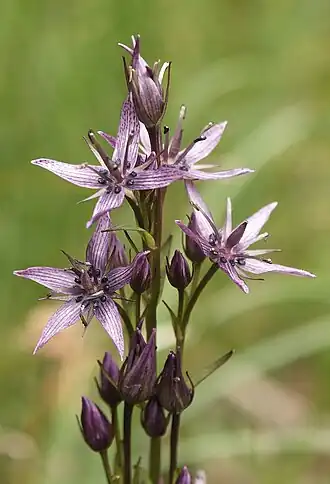
Swertia est un genre de plantes de la famille des Gentianaceae comptant environ 150 espèces, principalement en Asie et Afrique. Certaines espèces portent des fleurs violacées ou bleues[1],[2].
Ce genre est représenté en Europe par la seule espèce Swertia perennis L., la swertie vivace, protégée en France[3].
Des espèces généralement placées dans le genre Frasera sont parfois considérées comme appartenant au genre Swartia.
Liste d'espèces
Selon Catalogue of Life (17 août 2012)[4] :
- Swertia carolinensis
- Swertia gypsicoloa
- Swertia perennis
Selon ITIS (17 août 2012)[5] :
- Swertia perennis L.
- Swertia usambarensis Engl.
Selon NCBI (17 août 2012)[6] :
- Swertia abyssinica
- Swertia adolfi-friderici
- Swertia angustifolia
- Swertia bifolia
- Swertia bimaculata
- Swertia binchuanensis
- Swertia calycina
- Swertia chinensis
- Swertia chirayita
- Swertia ciliata
- Swertia cincta
- Swertia cordata
- Swertia crassiuscula
- Swertia cuneata
- Swertia decora
- Swertia delavayi
- Swertia dichotoma
- Swertia dilatata
- Swertia elata
- Swertia engleri
- Swertia erythrosticta
- Swertia franchetiana
- Swertia hispidicalyx
- Swertia japonica
- Swertia kilimandscharica
- Swertia kingii
- Swertia lactea
- Swertia leducii
- Swertia luquanensis
- Swertia lurida
- Swertia macrosperma
- Swertia marginata
- Swertia multicaulis
- Swertia mussotii
- Swertia nervosa
- Swertia obtusa
- Swertia paniculata
- Swertia pedicellata
- Swertia perennis
- Swertia petiolata
- Swertia pianmaensis
- Swertia przewalskii
- Swertia pseudochinensis
- Swertia aff. pseudohookeri
- Swertia pubescens
- Swertia punicea
- Swertia racemosa
- Swertia rosulata
- Swertia schugnanica
- Swertia souliei
- Swertia tashiroi
- Swertia tenuis
- Swertia tetraptera
- Swertia thomsonii
- Swertia volkensii
- Swertia wolfongiana
- Swertia yunnanensis
Constituants chimiques
Les swerties contiennent généralement des composants de type sawertiamarine, mangiférine (un xanthonoïde aussi présent dans les mangues) et amarogénitine[7] 1,5, 8-trihydroxy-3-méthoxyxanthone, 1-hydroxyl-2, 3, 5, 7-tétraméthoxyxanthone, 1-hydroxyl-3, 5, 8-triméthoxyxanthone, 1-hydroxyl-2, 3, 4, 6-tetraméthoxyxanthone, 1-hydroxyl-2, 3, 4, 7-tetraméthoxyxanthone, 1,8-dihydroxy-3, 5-diméthoxyxanthone, 1, 7-dihydroxy-3, 8-diméthoxyxanthone, 1, 3, 5, 8-tétrahydroxyxanthone, balanophonin, oleanolic acid, acide maslinique, et acide sumaresinolique[8].
Les Swerilactones de Swertia mileensis ont montré des propriétés anti-hépatite B in vitro[9].
Usage médical
Les composants des swerties sont utilisés pour traiter des désordres gastriques, et ces constituants actifs, particulièrement la mangiférine, se sont avérés avoir des propriétés hépatoprotectives, hypoglycémiques, anti-inflammatoires, anti-oxydantes, anti-tuberculeuses et antifongiques, ainsi que de nombreuses autres propriétés pharmacologiques[10].
Références
- ↑ http://www.iisc.ernet.in/~currsci/aug252005/635.pdf
- ↑ http://www.ansab.org/UserFiles/chiraito.pdf
- ↑ Swertia perennis sur INPN
- ↑ Catalogue of Life Checklist, consulté le 17 août 2012.
- ↑ Integrated Taxonomic Information System (ITIS), www.itis.gov, CC0 https://doi.org/10.5066/F7KH0KBK, consulté le 17 août 2012.
- ↑ NCBI, consulté le 17 août 2012.
- ↑ Journal of Ethnopharmacology 98 (2005) 31–35
- ↑ Li XS, Jiang ZY, Wang FS, Ma YB, Zhang XM, Chen JJ "Chemical constituents from herbs of Swertia mileensis" Zhongguo Zhong Yao Za Zhi. 2008 Dec;33(23):2790-3
- ↑ Geng CA, Zhang XM, Ma YB, Luo J, Chen JJSwerilactones L-O, secoiridoids with C₁₂ and C₁₃ skeletons from Swertia mileensis. J Nat Prod. 2011 Aug 26;74(8):1822-5
- ↑ Variation of active constituents of an important Tibet folk medicine Huiling Yang, Chenxu Ding, Yuanwen Duan, Jianquan Liu
Voir aussi
Liens externes
- (en) Flora of China : Swertia (consulté le )
- (en) Madagascar Catalogue : Swertia (consulté le )
- (en) Flora of Pakistan : Swertia (consulté le )
- (en) Catalogue of Life : Swertia L. (consulté le )
- (fr) Tela Botanica (France métro) : Swertia L. (consulté le )
- (fr + en) ITIS : Swertia L. (consulté le )
- (en) NCBI : Swertia (taxons inclus) (consulté le )
- (en) GRIN : genre Swertia L. (+liste d'espèces contenant des synonymes) (consulté le )
- Jepson Manual Treatment
 Portail de la botanique