Proconsulidae
| Règne | Animalia |
|---|---|
| Embranchement | Chordata |
| Classe | Mammalia |
| Ordre | Primates |
| Sous-ordre | Haplorrhini |
| Infra-ordre | Simiiformes |
| Micro-ordre | Catarrhini |
| Super-famille | Hominoidea |
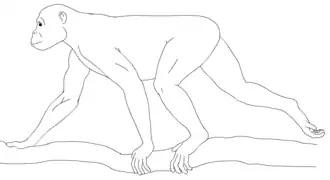
Les Proconsulidae sont une famille éteinte de singes catarrhiniens appartenant à la super-famille des Hominoidea, et ayant vécu en Afrique de l'Est durant le Miocène inférieur et moyen.
Arbre phylogénétique[Quoi ?]
Phylogénie des familles de singes, d'après Perelman et al. (2011)[1] et Springer et al. (2012)[2] :
| Simiiformes |
| ||||||||||||||||||||||||||||||
Sous-familles
Les Proconsulidae (Leakey, 1963) comprennent deux sous-familles éteintes de singes ayant vécu en Afrique de l'Est au Miocène :
- les Proconsulinae (Leakey, 1963)
- les Nyanzapithecinae (Harrison, 2002)
Proconsulinae
La sous-famille des Proconsulinae comprend 2 genres et 7 espèces, décrites sur la base de fossiles trouvés au Kenya et en Ouganda et datés entre 22 et 14 millions d'années[3] :
- † Proconsul (Hopwood, 1933)[3]
- † Proconsul africanus (Hopwood, 1933)
- † Proconsul major (Le Gros Clark & Leakey, 1950)
- † Proconsul gitongai (Pickford & Kunimatsu, 2005)
- † Proconsul meswae (Harrison & Andrews, 2009)
- † Proconsul legetetensis (Pickford et al., 2009)
- † Ekembo (McNulty et al., 2015)[3]
- † Ekembo nyanzae (Le Gros Clark & Leakey, 1950)
- † Ekembo heseloni (Walker et al., 1993)
Nyanzapithecinae
La sous-famille des Nyanzapithecinae comprend 6 genres et 10 espèces, décrites sur la base de fossiles trouvés au Kenya et en Tanzanie et datés entre 25 et 13 millions d'années[4] :
- † Nyanzapithecus (Harrison, 1987)[4]
- † Nyanzapithecus vancouveringorum (Andrews, 1974)
- † Nyanzapithecus pickfordi (Harrison, 1986)
- † Nyanzapithecus harrisoni (Kunimatsu, 1997)
- † Nyanzapithecus alesi (Nengo et al., 2017)
- † Xenopithecus (Hopwood, 1933)[4]
- † Xenopithecus koruensis (Hopwood, 1933)
- † Mabokopithecus (Koenigswald, 1969)[4]
- † Mabokopithecus clarki (Koenigswald, 1969)
- † Rangwapithecus (Andrews, 1974)[4]
- † Rangwapithecus gordoni (Andrews, 1974)
- † Turkanapithecus (Leakey & Leakey, 1986)[4]
- † Turkanapithecus kalakolensis (Leakey and Leakey, 1986)
- † Turkanapithecus rusingensis (Pickford et al., 2010)
- † Rukwapithecus (Stevens et al., 2013)[4]
- † Rukwapithecus fleaglei (Stevens et al., 2013)
Références
- ↑ (en) P. Perelman, W. E. Johnson et al., « A molecular phylogeny of living primates », PLoS Genetics, vol. 7, no 3, , e1001342 (PMID 21436896, PMCID 3060065, DOI 10.1371/journal.pgen.1001342, lire en ligne).
- ↑ (en) Mark S. Springer, Robert W. Meredith et al., « Macroevolutionary Dynamics and Historical Biogeography of Primate Diversification Inferred from a Species Supermatrix », PLoS ONE, vol. 7, no 11, , e49521 (ISSN 1932-6203, PMID 23166696, PMCID 3500307, DOI 10.1371/journal.pone.0049521, lire en ligne).
- 1 2 3 (en) Kieran P. McNulty et al., A systematic revision of Proconsul with the description of a new genus of early Miocene hominoid, 2015, PDF, lire en ligne
- 1 2 3 4 5 6 7 (en) Yutaka Kunimatsu et al., The latest occurrence of the nyanzapithecines from the early Late Miocene Nakali Formation in Kenya, East Africa, Anthropological Science, volume 125, numéro 2, p. 45-51, 2017, lire en ligne
Voir aussi
Articles connexes
 Portail des primates
  Portail de la paléontologie
  Portail du Cénozoïque
 .svg.png) Portail de l’Afrique
Portail de l’Afrique